
How much should you risk on one trade?
Keep it small enough that one loss cannot decide your week. The hosts did not give a magic percent. They showed what happens when one trade is too big.
Leander walked through the results of the paper trading showdown he and Preston ran with $5,000 each. He said one trade by Preston decided the entire week.
Preston agreed he got aggressive and got caught. Leander added that it did not matter how the other days went once one trade was that large.
The practical rule from the show: size every trade before you click, and make sure the worst case is a loss you planned for.
The Stampede app's Standard setting sells at +5% or -5%. Its other options are Low risk at 3% and Aggressive at 8%. This is education, not financial advice.
Why does paper money feel different from real money?
Because the emotion is gone. Leander said trading paper money and trading real money are two different things.
He said that if it had been his real money, he would not have entered his trades in that form. The contest added some emotion, but real cash would have been a different story.
That is a reason to treat a paper account as practice for your rules, not proof that you can handle real losses.
Use the free position size calculator to see what a stop-out would cost before you risk a dollar.
What should you set up before the 9:30 open?
Have every tool tested before the bell. Preston said he did not have all his alerts set up, and it hurt him.
His checklist: by about 9:15, make sure your API keys are linked to the accounts you will trade in. Then send a test message so you know the text alerts are arriving.
Leander's point was the same. Use the platform to filter the best stocks and the best times to be in them, instead of guessing which stock is hot.
Trading without the tools, Preston said, makes the process far harder than it has to be.
How do Stampede's buy points work on a stock like INO?
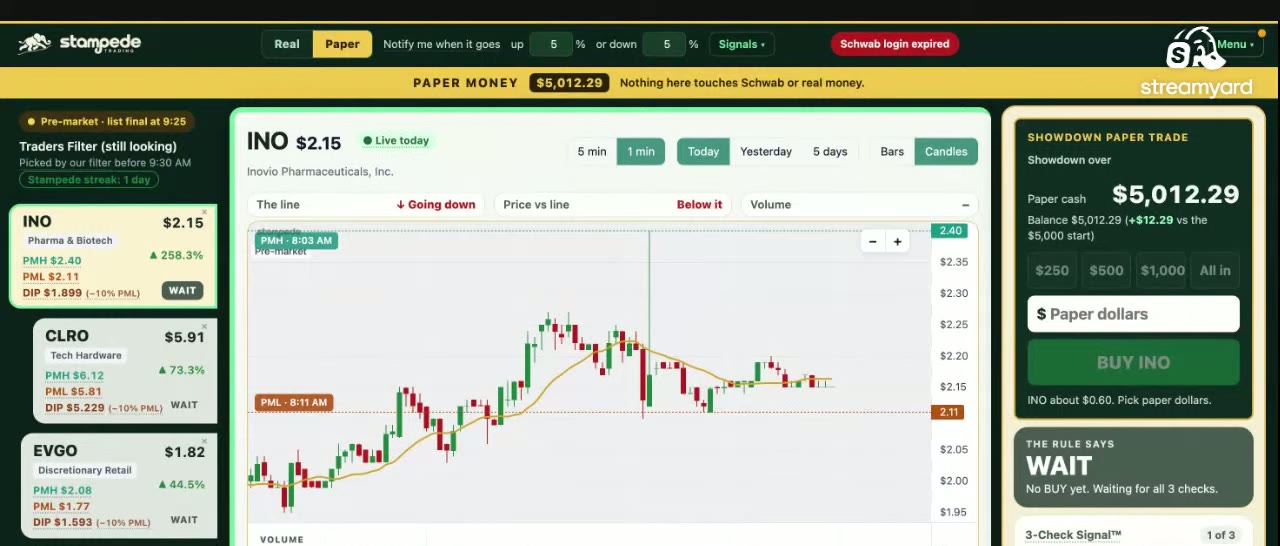
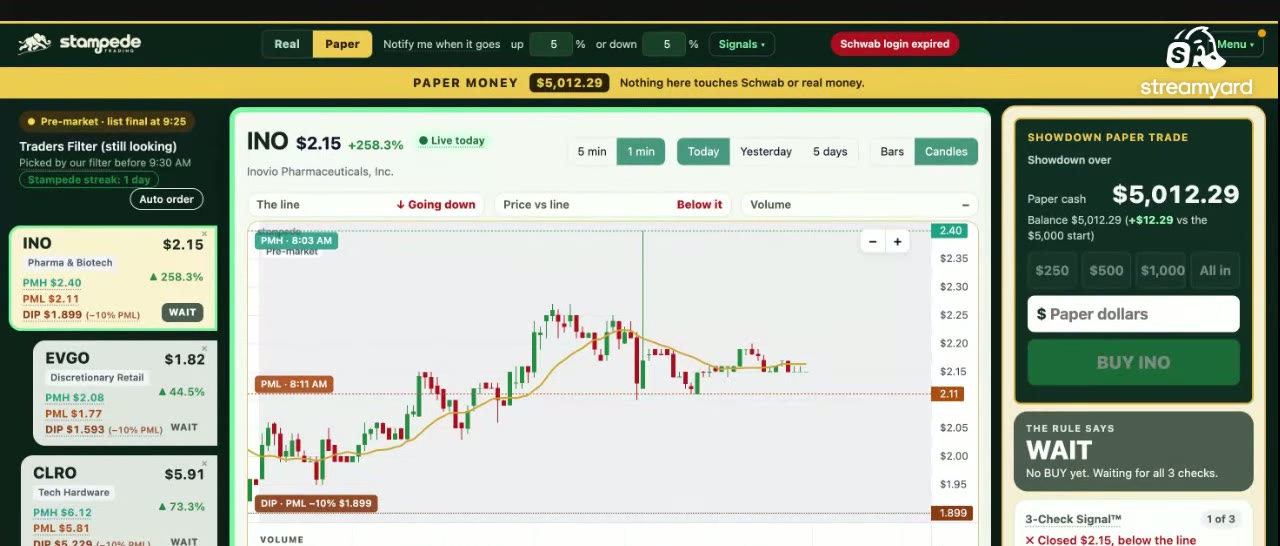
The buy point is the price crossing a rising moving average line, closing a one minute bar above it, with good volume. Preston looked at INO from the morning list.
He said INO was dropping below its moving average line, so he was waiting for a buy point to appear.
When it does, the moving average line should be trending up and the price should finish the one minute bar above it. Good volume makes the signal stronger.
Then he would have an order ready in his own brokerage account, so that when the text alert arrives he can act quickly.
The list that morning had four pre-market movers that passed the filters.
Should you trade paper money or real money?
You can do either. Leander described the Stampede platform as an educational coach. When the coach signals, you can follow along in the paper account, or place the trade in your own brokerage account.
The paper account starts as if you had $5,000. If you use real money, you go to your own broker to place the order, which one host compared to an open book test.
The signals are the same on screen as what the hosts see. You can follow along live with the same filtered list.
How should you spread your money across several signals?
Split your money across the day's signals so that no single stock can sink the account. Preston said he missed a big mover because all his cash was already in another stock.
His advice: if four or five stocks are available that day, spread the money over them. If you are in two, you may need to cut each position in half to leave a third of your money for the third.
You never know which one will move, he said. At least you will not take a big loss in just one, and the wins and losses may average out.
Stay with the rules, he added, so you stay out of trouble.
Your move
In a practice account, decide before the open how much one trade may lose, then size your shares from your stop to match it.
Terms used
Plan a trade with our free position size calculator or gap and risk/reward calculator.
Sources
Show recap · November 4, 2026