
What is the difference between a market order and a limit order?
A market order fills now at the current price, and a limit order fills only at the number you set. Preston explained that every stock shows a bid and an ask. The bid is what you sell for, and the ask is what you buy for.
With a market order you get whatever price is there at the moment you hit the button. The stock moves every second, so that price can shift slightly.
With a limit order, he said, the order looks to fill at the number you punch in. His example was a limit order at two dollars, which triggers when the stock reaches two dollars.
Preston said he likes market orders because he can get in right away before the price moves. He said that may not suit everyone, because some people want a particular price.
The SEC and FINRA both note the trade-off. A market order might not fill at the price you saw, and a limit order might not get executed at all.
Does a limit order fill at a better price than you set?
Yes, it can. Preston said many platforms will fill a limit order at a better price if the market has moved past your number by the time it reaches the exchange.
His example: you set a limit to sell at $2.10, but the stock is already trading at $2.14 when your order arrives. It fills at $2.14, not $2.10.
The same works in reverse for buying, he said. If the price moves past your number while you are on the review screen, you get the better price.
This matches the FINRA description. A buy limit order can be executed only at or below the limit price.
What happens when a limit order misses your sale?
You can set your limit, watch the price touch it, and still not get the sale. Leander shared a trade from the day before. He wanted to sell at $2.10.
He said that as he was typing in the limit, the price reached $2.10. By the time he locked it in, the price had dropped back down, and he lost the sale.
Later he looked at the chart and saw he had sold for $2.07 instead. He said he canceled the order and closed the position at the market price in his brokerage app.
Preston agreed it is usually easier to go straight to a market order, so you know you are getting as close as possible to the price on screen.
Both hosts said this is education only and not financial advice. Day trading has risks.
Does your internet speed change how a market order fills?
Yes, a slow connection makes the price you get less predictable. Preston said that years ago, on a dial-up modem, the price could move 10, 20 or 30 cents before you were in or out.
Today an order can fill within a second or two. But he said if you trade from a basement or a building with a spotty connection, make sure you have the best connection you can before you trade.
The SEC says the same in plain terms: delays can mean a worse price than the one quoted, especially in fast moving markets.
How do Stampede's buy and sell signals work on a real chart?
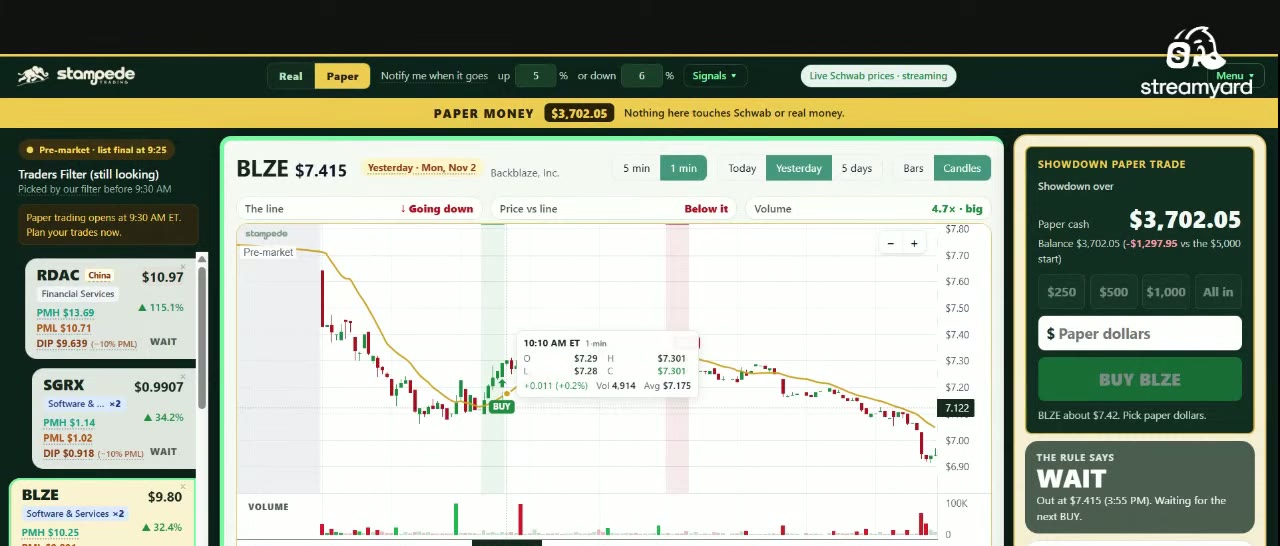
Preston took the screen and showed BLZE from the day before on the Stampede app. He walked through the three checks for a buy signal.
1. The price goes above the moving average line.
2. The moving average line is trending up.
3. Volume comes in.
When all three line up, the app sends a buy alert to your phone with an elephant sound, so you do not have to be watching. Preston still said to take a peek at the chart, because the signal is your eyes on it.
The sell works the other way. A small dot on the chart shows when price drops below the moving average. Then the line trends down and a sell signal follows, once there is a little volume.
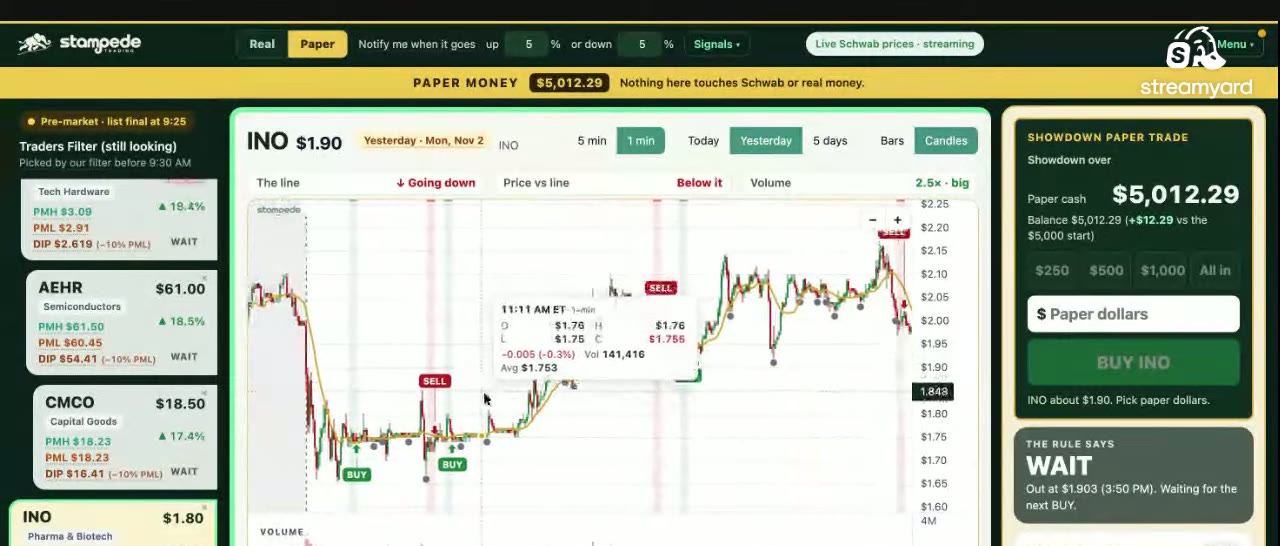
Leander also pointed to INO from the day before. The alert came around $1.75 and the sell alert near $1.96, and he said he followed all the alerts that day for the first time in a while.
What was the biggest takeaway from the show?
Leander's takeaway: a limit order is your price or nothing, and sometimes better. A market order is the current price and is quick to see and act on.
Preston gave his version. A market order tells your platform to buy or sell at the best available price. It is an immediate order, so you get the best price right when you press the button.
For the day's list, the hosts had four stocks on the board. Preston suggested spreading your money across them in case one runs. This is not a recommendation to buy anything.
Your move
In a practice account, place one market order and one limit order on the same stock, and note which price each one filled at.
Terms used
Plan a trade with our free position size calculator or gap and risk/reward calculator.
Sources
- SEC: Trade Execution, What Every Investor Should Know (market and limit orders, fast markets)
- FINRA: Order types (market and limit order mechanics and risks)
Show recap · November 3, 2026